





A wooden crate is a strong and sturdy container made from wood, typically used for storing and transporting various goods. It usually has slatted or solid sides and a removable lid. Wooden crates can be used for shipping, storage, and display purposes, and they come in a variety of sizes and styles to fit different needs. They are often preferred over other types of containers for their durability and sustainability.
Advantages of Wooden Crate
Durable and strong - Wooden crates are made of heavy-duty material that is strong enough to hold and transport heavy and bulky items with ease.
Longevity- Wooden crates are sturdy enough to last for many years, and they do not get easily damaged or worn out.
Cost-Effective - Wooden crates are relatively inexpensive compared to other packaging materials like cardboard or plastic.
Sustainable - Wooden crates are eco-friendly as they are made from naturally sustainable materials.
Customizable - Wooden crates can be custom-made to fit specific product dimensions, which improves safety and saves space.
Protection - Wooden crates provide excellent protection for fragile items such as glass, ceramics, and electronics, preventing them from damage during shipping or transportation.
Easy to handle - Wooden crates are easy to handle as they come with grips and slots that allow for easy handling and maneuvering.
Reusable - Wooden crates can be used multiple times as they are durable and do not easily wear out.
Recyclable - Wooden crates can be easily recycled, reducing waste and environmental pollution.
Aesthetically pleasing - Wooden crates have a natural, aesthetic look that adds to the appeal of the product and can be used to create a rustic and vintage look.


Why choose us?
Efficiency and service
Our sales team needn't a cumbersome approval process, and sales staff can quickly respond to customer inquiries and questions.
Quality Control
We have our own quality control team, they will be involved in the packaging process of the goods, and check the product one by one before it is boxed.
Analysis Report
We will do a lot of market research, which will provide some reference for your work.
Management
We are highly cooperative and open to exploring more possibilities.
We are willing to accept trial orders to evaluate our qualifications,which minimize the customers' risks.
Competitive Price
We are indeed not a huge factory, just because of this, all our expenses are spent on products only, not on various advertisements. We can offer a quite competitive price.
Win-win Awareness
We are committed to providing our customers with the competitiveness they need to compete in larger markets.
Advantages of Using Wooden Crate for Packaging


For as long as human civilisation has practiced carpentry, we have used timber for packaging. These early days saw wooden boxes or crates as the solution for an individual or pair to move larger, heavier loads than they could on their own. Nothing has changed.
Wood remains a prominent material for transporting goods. However, the language seems to increasingly give new names to the essential wooden structure.
From pallets to crates, moulded custom shipping to containers for protecting wine, the world loves to move its products in wood. But why should your next shipment be protected by wooden packaging?
Durability
One of the best reasons to use wood over steel or plastic is wood's durability in transit. Snow, sun, wind, rain, getting knocked, splashed with sea water or baked in deserts. In these conditions and more, steel would corrode or overheat products, plastic would crack or scratch, cardboard melts, warps or grows mould, but wood takes this abuse all while protecting your product.
Relatively Low Cost Compared to a Full Case
Wooden packaging, particularly standard crates and pallets, can be made from off-cut, cost-effective and reused timber stock. This provides businesses with a functional shipping option without denting margins.
Weight (Much Lighter Than a Full Case)
Timber crates are designed to handle impacts, vertical weight while using less material than full wooden or plastic cases. Crates are made of the structurally significant planks of a case, without the extra weight of side and top boards. This leaves a rigid structure with much reduced packaging weight, saving your shipping rates.
Visibility of the Packed Product
The product inside a crate is readily visible. This means your goods are quickly identifiable, allows produce to breathe, and may even be showroom ready.
Stackable and Efficient Storage and Shipping
Thanks to our crate design, they are equal in strength to a full wooden case. The bracing and stacking requirements of a wooden crate ensure design is focused on strength in the structure. Steel is stronger, but is very heavy, cardboard lighter, but vulnerable to moisture, and has limited capacity for vertical pressure from stacking. Wooden, breathable and lightweight crates also offer an excellent solution to mid or long-term storage.
Eco-Friendly (Reusable and Recyclable)
Plastic, steel and even Medium Density Fibreboard (MDF) require energy and processing plants to create. Conversely, timber is as natural and renewable resource as available. Additionally, the longevity and natural resilience of wood means many crates can be used and reused for years. This increases the value of construction costs every trip.
Wood Crates vs Cardboard Boxes: Which Is Best for Your Shipping Needs?
For hundreds of years the shipping industry has utilized wood crates to safely transport goods. Other types of shipping methods have come out in more recent years, though, including the cardboard box. Carboard has proven to be a cheaper material for shipping goods, and since businesses who ship frequently are always looking for ways to save money, this may sound like an attractive alternative to the traditional wood crate. But is cardboard better than wood when it comes to shipping containers? Find out the pros and cons of each to discover which shipping method is best for protecting your shipments.
Cardboard Boxes: Advantages
Carboard boxes, otherwise known as corrugated boxes, are made from corrugated kraft paper or fiberboard. This shipping material has become widely used to transport goods, especially for those smaller in size. The main advantages of shipping in cardboard containers include:
Cost - The cost of cardboard is low compared to wood and other packaging materials. This is one of the main reasons why businesses will choose to ship goods in cardboard.
Easy accessibility - Cardboard boxes are easy to open. All the recipient needs to do is cut or pull off the tape that seals it shut.
Lightweight - Cardboard does not weigh much, which means it contributes little to the shipping weight. It is useful for shipping goods that are also lightweight.
Handling - Cardboard boxes are easy to handle during transport. This is due to their light weight and standard shapes and sizes.
Environmentally friendly - Less wood goes into making cardboard, which means you can make more cardboard boxes with one tree than you could wood crates. Cardboard boxes can be recycled and decompose faster than wood as well.
Printability - It is easy to print a logo or design onto cardboard to customize a box with your business's name or logo.
Wood Crates: Advantages
A wood crate is a box built out of wood with the purpose of protecting a shipment from potentially damaging conditions during transportation. Wood has been the primary shipping material for hundreds of years, and for good reason. Here are a few of the biggest advantages to shipping your goods in wood crates:
High level of protection - Wood is a very strong material, which means it can withstand rough handling without compromising its integrity. Your shipment will remain safe and secure despite any less-than-ideal transportation circumstances. Wood can even keep out moisture to keep shipments safe from poor weather conditions.
Customizable - A wood crate can be built to meet the specific dimensions of any shipment, no matter how big or small. This customization means there won't be too much extra space for your goods to move around and become damaged during transportation.
Easy to repair - If a wood crate somehow gets damaged, it doesn't become useless. Unlike cardboard, it can be repaired and made good as new.
Reusable and recyclable - Because wood maintains its strength and integrity for a long time, wood crates can be reused time and time again. Once you are done with them, wood shipping containers can be broken down, and the wood can be reused for other projects or shredded into mulch.
Can support heavy loads - Wood's strength and durability allow it to keep its shape even under the stress of a very heavy load. This makes wood crates ideal for shipping heavy pieces of equipment.
Cost-effective - While the price of wood is higher than that of cardboard, the reusability of wood crates means you will not have to buy them as often, which will save you money on shipping containers over the years.
Stackable - Because wood crates can withstand a lot of weight, they can be stacked on top of one another, saving you storage space.
As you can see, there are more advantages and fewer disadvantages of using wood crates compared to cardboard boxes. If you want to ensure your shipment will get to its destination safely and undamaged, then you should ship it in a wood crate. A wood crate can protect your goods from rough handling and will withstand poor weather conditions. Though the initial cost per wood crate is higher than that of a cardboard box, this cost is worth it to keep your shipment protected during transport and storage.
As with most other wood packaging products, wooden crates are sustainable and environmentally friendly. For many manufacturers, creating a greener supply chain, being more environmentally friendly, and shrinking carbon footprints is highly prioritized initiative. Obviously, using industrial shipping crates made from wood isn't going to get you there alone, but it's a big step forward if your manufacturing company is focused on sustainability.
If you're wondering if wooden crates really fall into the category of sustainable, then there are a couple of facts to consider.
This type of transportation packaging can be reused multiple times, then repaired and used some more.
When they are worn out, they can be cannibalized for parts for other packaging, or the wood can be used for other things – everyone has seen all the used wood projects out there.
When wooden crates have lost their usefulness and can't be cannibalized any further, they can be ground up for mulch, wood pellets, or animal bedding. Eventually, the wood breaks down and returns to the earth to help new things grow.
It's hard to imagine how wooden crates could be any more environmentally friendly than that.
As an added bonus, they can be easily stacked, making them very easy to story and reuse.


We've already alluded to the fact that wooden industrial shipping crates are economical, but it probably deserves a place in the discussion. As we said earlier, it makes sense to place large, single items in a crate and ship them LTL when you can, rather than using a steal container. Even if your single product took up a whole truck by itself, it would be more economical to use a wooden crate. Steal containers are more expensive and they weigh a lot more than a wooden crate.
If your products require a custom sized crate, then plastic probably won't work for you. Either you buy whatever off-the-shelf size they have to offer and then pack it with materials like corrugate and foam to keep it safe, or you pay through the nose to have a custom size created for you. The cost of packing in the extra materials will add to the overall cost, so neither plastic crate option is very cost effective.
Cardboard or corrugate could be a viable option for many manufacturers. In this type of a scenario, a wooden base would be created, and corrugate sidewalls and lid would be affixed to it. This is something that we do for some of our clients, and it can be quite cost effective, depending on the mode of transportation and the distance being shipped.
When you're looking at the overall costs of your packaging, you should also consider the cost of in-transit damage. Some types of transportation packaging are more prone to in-transit damage than others. Wooden crates provide a complete barrier between your product and the environment, which can significantly lower the damage that your products sustain during transport.
When you factor in the cost of damaged products, or lack of damage in the case of wooden crates, then this type of packaging is often much more economical.
Lastly, consider that wooden crates can be reused multiple times. This increases the lifetime value of each crate and lowers the overall cost. You can even design wooden crates specifically so that they can be reused.
Overall, wooden crates prove to be much more economical than many other forms of transportation packaging.
As a purchasing manager, you may not realize that a lot of manufacturers prefer to use wooden crates over other options for industrial shipping crates. Obviously, proper protective packaging is essential to limit in-transit damage and transport your products safely.
You have a lot of options for shipping your products, such as pallets, wooden crates, multi-material packaging, and even steel industrial shipping crates. With so many options, it pays to know what will best fit your particular application. There are many factors that make wooden crates more practical, affordable, and sustainable than other types of transportation packaging.
Here are some things to think about as you work to determine the best packaging solution for your product and its destination.
How Far Are Your Products Going?
If your products have an international destination, it's not unusual to think of using a large cargo container and putting your products on a cargo ship. Some companies even use cargo containers for shipments inside of the United States.
For many domestic shipments, cargo containers are just overkill and may not fully protect your products if you aren't using additional packaging materials, such as pallets, wooden crates, corrugate, foam, etc.
Cargo containers are also pretty expensive to use as industrial shipping crates for domestic shipments, unless you can fill the entire container. If you're shipping a single, large item, you can often save on costs by using a wooden crate and shipping it LTL (less than truckload), instead of using a steal container that takes up the entire truck. The wooden crate will protect your product while it gets shipped with other items on the same truck.
Wooden Crates Are Strong and Secure
During the packing, loading, unloading, and transport of your products, your transportation packaging can encounter a lot of mechanical stress that puts your products at jeopardy of being damaged. Wooden crates are built for that kind of abuse. This type of industrial shipping crate is built to handle not only the load, but the mechanical stress as well.
Even with very heavy loads, properly designed wooden crates protect products with little risk of damage.
In addition, wood crates provide the kind of security that isn't found in other transportation packaging, such as pallets. Wooden industrial shipping crates usually have the product completely sealed up inside. The walls of wooden crates are often screwed together, making it more difficult for anyone to nefariously get to the products inside. Products are also much less likely to fall of the truck, as can occasionally happened with palletized products that aren't secured properly.
Characteristics of Wooden Crates
Wooden crates are one of the most secure ways to transport goods. Their solid build protects the commodities inside, and provides an easy-to-handle format that forklifts and pallet jacks can maneuver. Wooden crates are durable, reusable, and an earth-friendly option for packaging and shipping supplies.
Considerations to keep in mind
Probably the most durable of packaging materials, wooden crates protect your shipment and ensure that it arrives at its location undamaged.
Features of a well made wooden crate
Screw or latch closures ensure secure fastening of your cargo.
Properly placed skids. These make sure your shipment is kept off the ground and prevents damage, as well as providing easy handling by machinery, like forklifts or pallet jacks. This is critical if the shipment is very heavy.
Handles are well positioned. If handles are a part of the design, make sure they are well placed for ease of use.
Appearance. A well made crate will have a good “look” to it, and although it doesn't necessarily class as beautiful, it should look decent.
Recessed hardware. If you have handles or hinges, you don't want them to break off midway.
Appropriate labelling. Make sure that you put directional arrows and appropriate warnings to your wooden crate before shipping. Never label valuables as such or use the label “Art.” Label such items as “Fragile.”

Our Factory
Shandong ZhiDian Enterprise Co., Ltd is founded by a team who has profound experience with wooden products. Many years ago we were just a local factory providing OEM services for Chinese trading companies, without our own export rights. We gained the export rights in 2019 to export by ourselves.
Now our business not only includes unfinished wooden crafts, but we also supply wooden home decor, wooden seasonal cutouts shapes, storage boxes, and disposable wooden cutlery to the world.


We're professional wooden crate manufacturers and suppliers in China, specialized in providing high quality products and service. We warmly welcome you to wholesale high-grade wooden crate at competitive price from our factory.
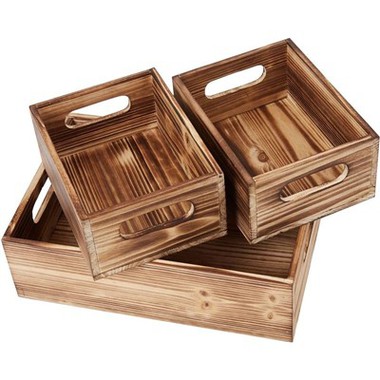
Set Of 3 Distressed Storage Wood Crates, Stackable Decorative Wood Crates Set Of 3, Wooden Nesting Crates With Handles